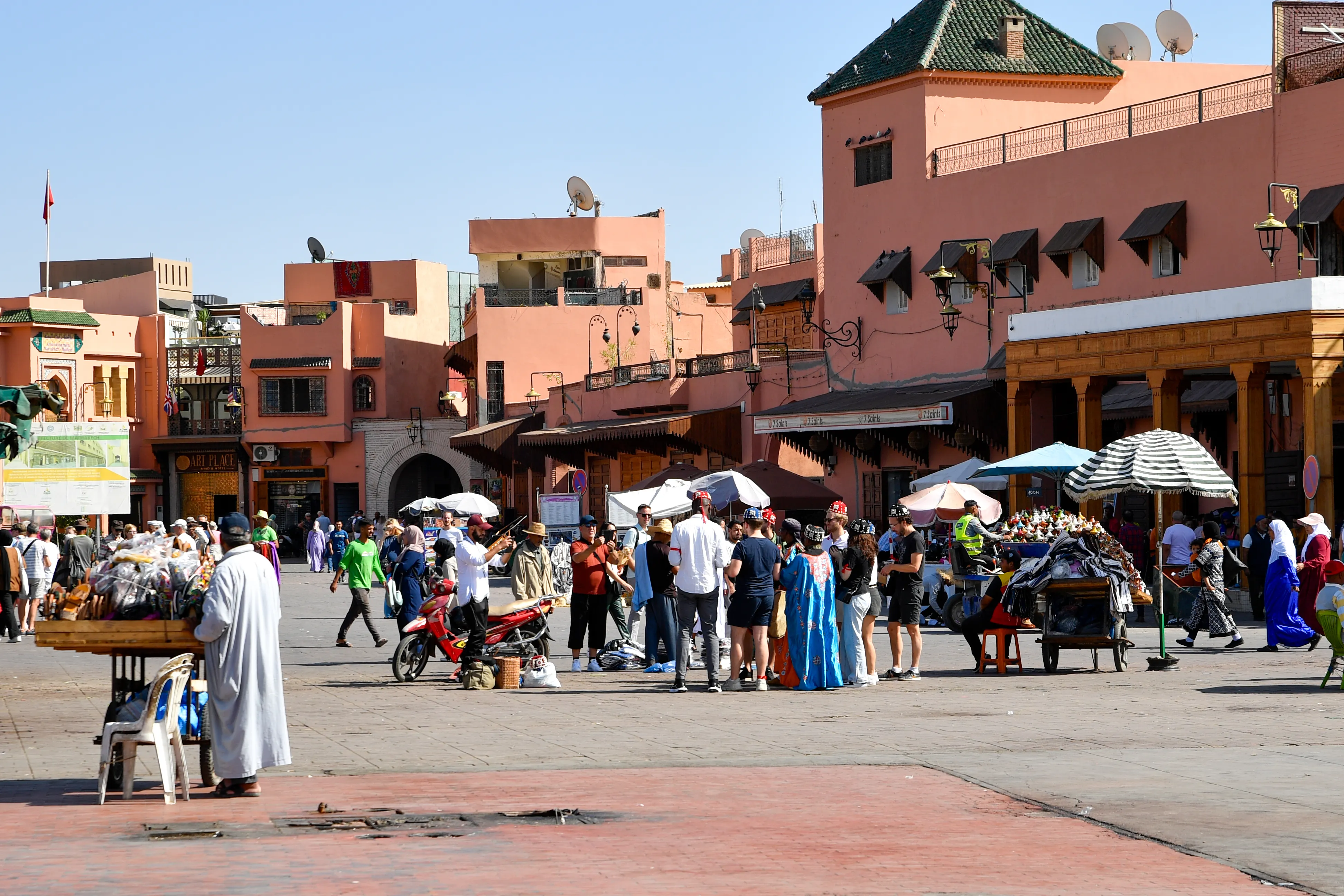
Day 1 — Arrival • Jemaa el-Fnaa Magic 🌙
By UserCarte · 5 min read
Marrakech does not ease you in. You step out of the airport into dry, sun-warmed air, and within half an hour you can be standing at the edge of Jemaa el-Fnaa while the call to prayer rolls over the rooftops and the smoke from the grill stalls climbs into a pink sky. Day one is not about ticking off monuments — the Bahia Palace, the Saadian Tombs and the souks can wait. Today is about arriving properly, finding your bearings in the medina, and letting the big square do what it has done to travellers for a thousand years.
The plan below assumes a midday-to-afternoon landing, which is when most European flights touch down. If you arrive late at night, skip ahead to the square — it stays alive well past midnight — and shift the daylight wandering to the following morning.
From the Airport into the Medina
Marrakech Menara Airport sits remarkably close to the city, and the ride into the old town is short — often under twenty minutes outside of rush hour. You have three sensible options. A pre-arranged transfer through your riad is the most painless: someone meets you with your name on a sign and, crucially, walks you through the final stretch of pedestrian-only alleys. Airport taxis are plentiful but fares are negotiated rather than metered, so agree on a price before you get in and have small notes ready. There is also a city bus that runs between the airport and the edge of the medina for a fraction of the cost, useful if you are travelling light and unhurried.
Whatever you choose, understand this: no vehicle will reach your riad door. The medina is a maze of derbs (alleyways) too narrow for cars, so expect to be dropped at the nearest recognisable gate or square and walk the last few minutes. Screenshot your riad's location and the name of the nearest landmark before you land, because phone signal and your sense of direction will both wobble in there.
Settling In: Riad Life and a Rooftop Reset
Sleeping inside the medina on your first night is worth it. A riad — a traditional house built around an internal courtyard, usually with a small plunge pool and orange trees — flips the city's intensity inside out. Outside the door is noise and motorbikes; inside, it is cool tiles, silence and mint tea poured from a great height. The trade-off is luggage-dragging over uneven ground and the odd moment of getting hopelessly lost, which is part of the deal.
Drop your bags, drink the welcome tea, and then go straight up to the roof terrace before sunset. Almost every riad has one, and it is the single best orientation exercise in Marrakech: the Koutoubia minaret to the west, satellite dishes and storks, the Atlas Mountains smudged blue on the horizon on a clear day. Ten minutes up there and the medina stops feeling like chaos and starts feeling like a map.
Jemaa el-Fnaa as the Light Goes
Time your arrival at the square for the hour before sunset. By day, Jemaa el-Fnaa is a wide, hot, slightly underwhelming open space with orange juice carts and a scattering of performers. As the light drops, it reassembles itself completely: dozens of food stalls wheel in, strings of bulbs flicker on, drum circles form, and the smoke and noise build until the whole thing feels like a single organism.
Walk a full loop of the perimeter first without stopping. This lets you see the shape of it — the juice sellers on one side, the Koutoubia Mosque floodlit beyond, the souk entrances swallowing people whole at the north end. Then find a café terrace on the upper floors along the square's edge, order a mint tea or a coffee, and simply watch from above for half an hour. This overhead view is the photograph everyone wants, and it costs nothing more than the price of a drink.
A note on the performers: the monkey handlers, snake charmers and henna artists earn their living from tourists, and animal welfare here is genuinely poor. If you photograph anyone or accept a henna design, payment is expected and will be pushed for firmly. The simplest approach is to decide in advance what you will and won't engage with, keep walking politely when you're not interested, and carry small change for the storytellers and musicians you do want to stop for.
Dinner at the Food Stalls
Eating in the square is the point of day one. The numbered stalls all cook essentially the same repertoire — grilled meat skewers, merguez sausage, lentil soup, aubergine salads, tangia, and for the brave, snail broth and sheep's head. Touts will compete loudly for your attention with menus and jokes; ignore the hard sell and use the local test instead, choosing whichever stall has the most Moroccans eating at it and the highest turnover of food off the grill.
Sit at the communal bench, order less than you think you want because dishes arrive fast and generously, and confirm what things cost before they land. Finish with a glass of freshly squeezed orange juice from one of the carts — cheap, ubiquitous, and somehow better here than anywhere else.
Practical Tips for Your First Evening
Bring cash. Morocco runs on dirhams, stalls and taxis rarely take cards, and ATMs cluster near the square's edges rather than deep in the medina. Withdraw at the airport or on arrival so you are not hunting for a machine at 10pm.
Dress modestly — shoulders and knees covered is respectful and also keeps the sun off. Wear shoes you can walk uneven stone in. Keep your bag zipped and in front of you in the crush of the square, which is safe but pickpocket-prone like any crowded place. And when you finally head back, aim for a major gate or the Koutoubia rather than trying to navigate alley by alley; from a landmark, your riad is always a short, findable walk away.
Go to bed early if you can. Tomorrow the souks open, and they will want all of your energy.